
On the Road Again ...
Donegal, Cork, Kerry counties, plus the way I cook a rack of lamb, reading and viewing suggestions, and more ...

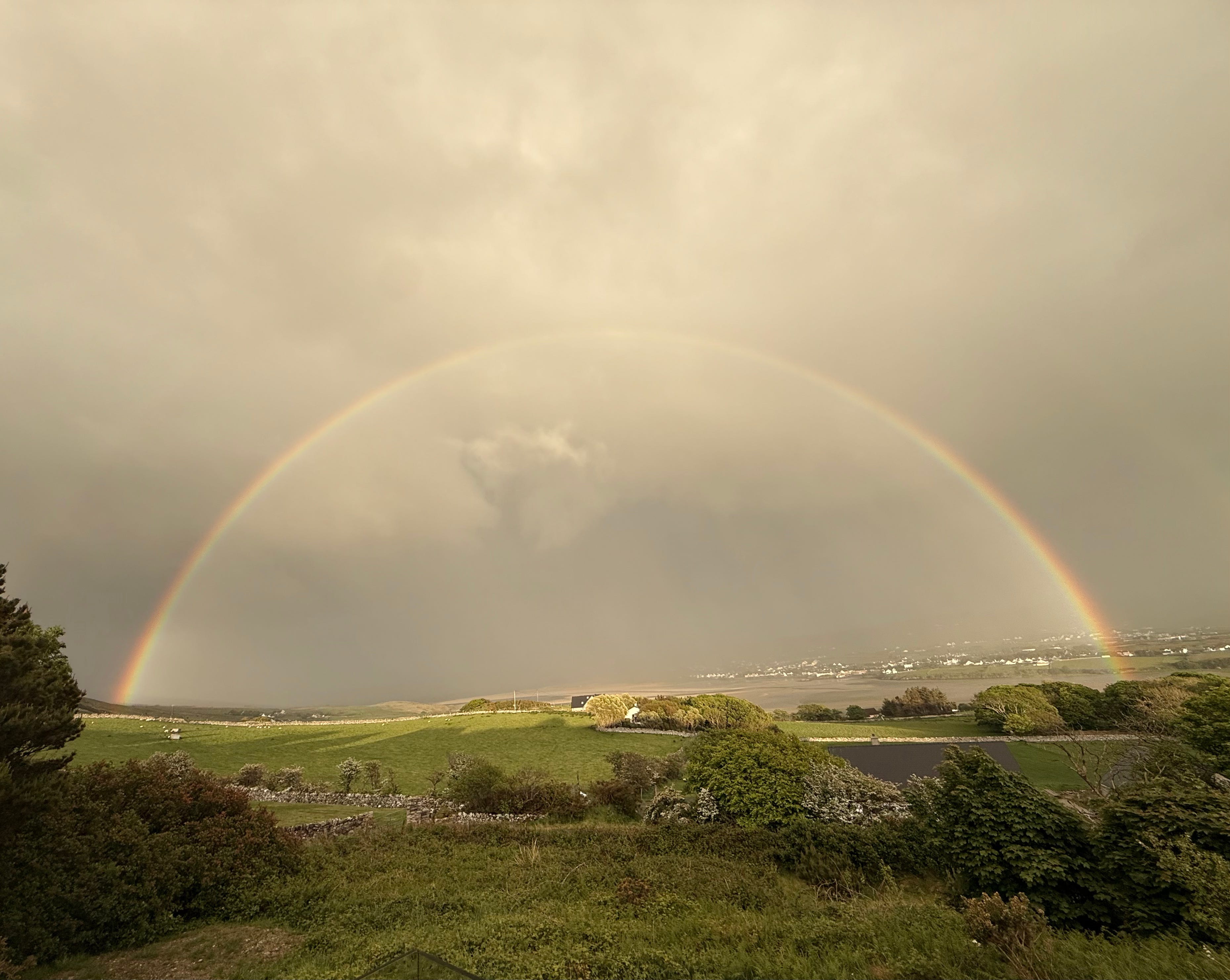
Ten years ago, on assignment for Saveur magazine, I wrote about Dingle, a town on a peninsula in southwestern Ireland. I covered its thriving food scene and also its emotional power. Where once the weekly menu consisted mainly of boiled beef and cabbage, followed the next by potatoes and cabbage, followed by bacon and cabbage, Ireland now seemed a land of culinary plenty.
I’ve returned here almost every year with Ann, who co-runs a writers’ workshop each spring. A sign we see outside our B&B proclaims it the number one foodie town in Ireland. Regrettably, while it remains a fertile land with good food, its culinary status has fallen a considerable degree. Two of the main chefs and restaurants I wrote about have quit their business.
My friend Martin Baelin closed his restaurant, Global Village, because he couldn’t find the staff for the kitchen after Covid. Kevin Murphy couldn’t support his very fine cuisine and departed for Dublin. Our beloved Chart House closed.


Even our dear B&B, Bambury’s Guesthouse, no longer offers a full Irish breakfast in the morning, owing to the fact that the proprietor can’t find any cooks. It still has a few good restaurants—there’s a new one we’re eager to try, 505, across from the cinema being refurbished by Cillian Murphy—and Kennedy’s butcher shop was taken over by a young American couple and still sells some of the finest lamb in the county.
But what it’s always been known for, and remains the best for, are pubs and traditional music.
The best food scene, and best by quite a bit, can be found south of Dingle in the coastal town of Kinsale, County Cork. (We’ve read that Abbeyleix and Carrick-on-Shannon are likewise great but both are way inland and we love the coast.)


It’s a colorful town as the photos show. Of note here above, the best fish and chips we’ve had ever was at Fishy Fishy; a truly fine used bookstore/winebar called Prim’s; smoked duck breast with a soy dipping sauce at the excellent Black Pig; some of the last hand-cut crystal can be found at Kinsale Crystal; I was happy to see several live-aboards tied up to the stone wall of its harbor; and crab toes are in season!
From Donegal to Cork …
There is simply no easy way to travel north-south in wesstern Ireland, a problem that is especially acute when you find your self on the northern coast of Ireland and have a room waiting in Kinsale on the southern coast.
Hour drive to Donegal airport.
Short flight to Dublin.
Taxi to Heuston station.
Train to Cork.
A bus to Kinsale, concludes the 10-hour journey.
But Ann had her sights set on a boutique B&B in remote Donegal as our first destination, just outside the town of Dunfanaghy. It was a gorgeous and restful entrance into the country, and the B&B itself, Breac.House, is one of the most elegant, easy, and refined places we’ve stayed in a long time. The owners, Niall Campbell and Cathrine Burke, could not be more welcoming.

The design of the place, Scandanavian in feel, is natural and practical and spare. We would find morning breakfast in small cubby in our room, placed there from the hallway, so we wouldn’t be interrupted or have to leave our bed for our morning coffee.


We could enjoy a late morning walk to the coast and its spectacular views and treat ourselves to a seaweed bath in the afternoon. In the evening, cocktails using local gin and using local whiskey, were prepared for us in the living area. (The bath and the cocktails we learned on our last night were complimentary.)


Above, Breac House and the sleek decor of a warm and elegant home; gin and tonics with seaweed with a game of Spite and Malice. Picnic lunches are included and come in nifty little containers. About a mile from the house is the northern coast and an extraordinary beach.
For dinners, we had plenty of options. We found an unexpectedly fine meal at The Olde Glen Bar and Restaurant on our first night, thanks to Chef Ciaran Sweeney. You wind your way through a traditional, ordinary-looking pub to a back room where a topflight kitchen is in operation offering several amuses and three complex courses. We ate fabulous smashburgers at Batch in nearby Falcarragh and excellent pizzas at the Rusty Oven in the center of Dunfanahgy. We caught some traditional music after, next door at Patsy Dan’s pub.
I loved how easy and impromptu the gathering of musicians is, all the beer bottles covering the table.
So Dublin to Donegal, Donegal to Kinsale …
And at last to Dingle …
One of the pleasures of the writers’ workshop this year has been hosting Luis Urrea, who read a killer short story to the group, his wife Cindy, and a surprise guest, our friend Mary Norris, famed for her work as The New Yorker’s Comma Queen, who, naturally, gave a talk on the comma (one of our favorite topics, grammar nerds that we are). Her T-shirt read “Let’s eat kids.” And below it, “Let’s eat, kids.”
One of the highlights of the weeklong workshop is the day off when we head to our friend Colleen Herlihy’s house, and I prepare racks of lamb for faculty and spouses.
I promised to tell Colleen how I cook the lamb—and Kerry Co. lamb is some of the world’s best—so herewith a very simple method with delicious results. (The lamb itself comes from Paul Malcolm and Ellen Campbell, mentioned earlier, expats who took over Gerry Kennedy’s butcher shop to create The Dingle Butcher. More on Paul and Ellen in a future newsletter.)
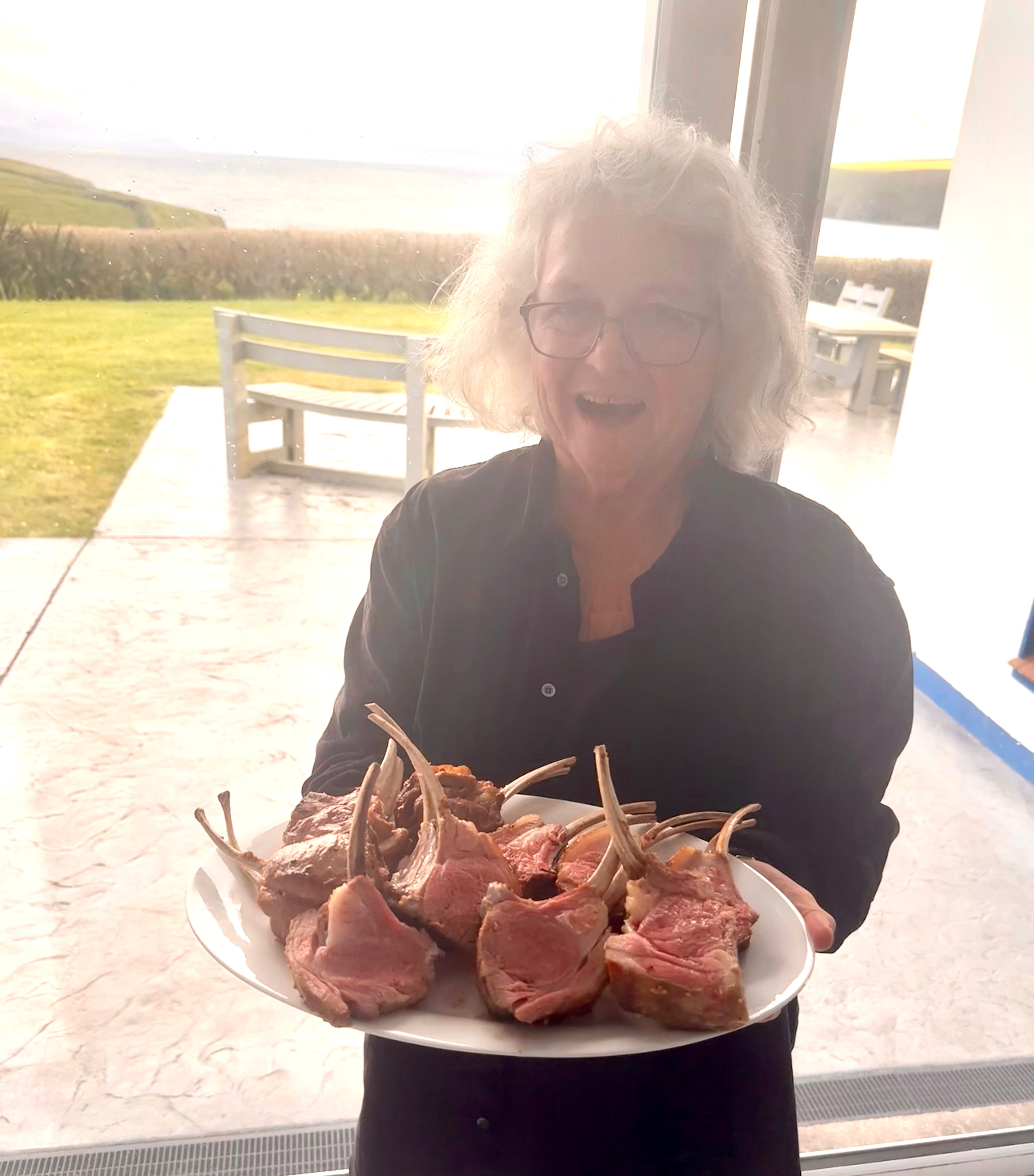
Kerry County Rack of Lamb with Rosemary and Garlic
Of course, giving lamb some heat over live coals is never a bad idea, but when I don’t have that option, I always pan roast it, searing it on the stovetop first, then adding lots of butter to the pan along with garlic and rosemary with which to baste the meat.
The two most important factors in cooking a perfect rack of lamb are these:
Leaving the lamb at room temperature for about four hours so that it’s well tempered before cooking. You don’t want to start a rack straight out of the fridge, when it’s 40 degrees inside.
It must rest for a good ten minutes once it comes out of the oven. This way, all the temperatures equalize and it finishes cooking in the center.
Other than that, it’s dead simple.
I like to serve two ribs per person. A rack typically has nine ribs, so one rack for four people, with a little extra chop for the cook.
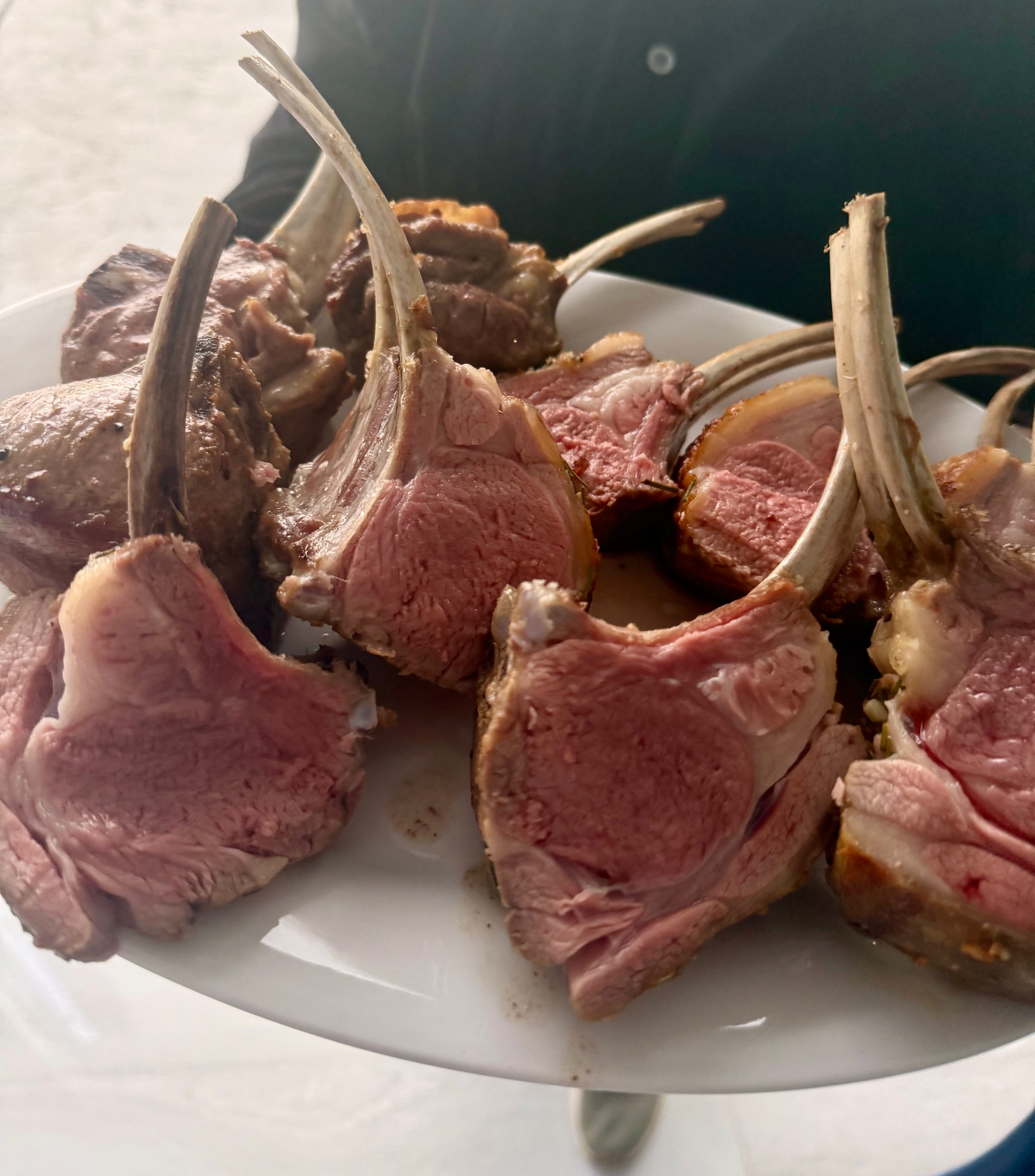
We were a dozen strong, so I cooked several racks. But the method is the same.
2 nine-rib racks of lamb
salt and pepper to taste
oil for sautéing
4 ounces, or one stick, butter
4 to 5 cloves garlic, peeled and lightly smashed
4 to 5 large stems of rosemary.
Salt and pepper the lamb when it comes out of the fridge. (You can rub the fatty exterior with oil to ensure salt and pepper stick there.)
When ready to cook, heat the oven to 400˚F. and get a heavy duty sauté pan hot over high heat. Add some vegetable or olive oil and when that is hot add the lamb, fat side down and cook it till it’s golden brown. Timing can vary, so use your eyes: when the fat side is nicely brown, turn the rack and cook the other side. You may want to hold the bones upright to brown so the entire exterior of the rack is browned.
Add a stick of butter to the pan, and when that’s melted, add the garlic and rosemary and swirl the butter to coat these aromatics. Baste the lamb.
Put the pan in the oven and cook for 20 minutes or so for medium rare, basting every five minutes with the frothy rosemary-garlic butter. (It should be firm-squishy, not spongy squishy, which would mean it’s still rare; lamb’s best medium rare).
Remove the lamb to a cutting board and pour what butter remains over the racks. Let the lamb rest for ten minutes. Slice the lamb between every second rib and serve. (Colleen had bought a nice mint sauce, which of course goes well with it.)
Serves 8
What we’re drinking …
Guinness, Guinness and more Guinness. Because you can only get it here, where it’s fresh and always held at the right temperature. Yes, there are taps of it all over the world and cans and bottles, but the experience of drinking a freshly drawn and rested pint of Guinness at a good pub in Ireland compares in pleasure to none other.


And there is no better sip of like-no-other libation than the very first, when the sweet creamy head mixes with the rich yeasty stout. I rarely drink Guinness outside of Ireland so when I’m here I take my fill!
The End of Slate’s Culture Gabfest … Say It Ain’t So! …

I listen to two podcasts religiously: The Daily and Slate’s Culture Gabfest. Every Wednesday I’ve looked forward to the thoughts and critical commentary of Dana Stevens (above, center), Julia Turner, and Stephen Metcalf. Eighteen years they’ve been gabbing, and as some have noted, they were among the first to show that a cultural criticism podcast can attract a big, devoted audience.
We’ve been listening to them so long I feel like they’re actual characters in my life. Julia is the mom figure, Dana the cool big sister, and Stephen her fraternal twin who always appears carrying a copy of the London Review of Books stuffed into a volume of Kant’s Critique of Pure Reason. I love these people and what they do so much, I once applied for a part-time assistant when they put out an offer. Seriously.
I’ve relied on Metcalf’s judgment to inform my own, and Stevens’s movie critiques, and just the three of them, their overall thoughtfulness and intelligence and sheer chemistry. I don’t reckon they can be replaced. They are, as Metcalf might put it, sine qua non. Damn, will they be missed.
What we’re reading …
Stopping in Prim’s bookstore/winebar in Kinsale after dinner, dim and candle lit at that hour, Ann immediately spotted a Ray Carver volume we didn’t know: No Heroic’s, Please (1992). It’s a collection of previously unpublished and published material, early stories, essays on Chekov and Hemingway, and criticism. His words on revision are worth the price of the book.
We returned to the place the next day to look some more and Ann found a book by Irish writer Sebastian Barry. Do you know him? He wrote a book Ann loved called A Long, Long Way, and she was delighted to find The Secret Scripture. I was trapped in a mediocre novel and Ann gave it to me.
Why are Irish writers. So. Damn. Good? Like Niall Williamson, Barry’s deep perception and sheer storytelling are astonishing. Here, a thoughtful doctor tries to determine whether a 100-year-old woman should be released from the mental institution she’s in, uncovering her haunted, shifting past as well as his own grief and misdeeds.
Ann Hood, The Promiscuous Reader, weighs in with this week’s endorsements:
I’m back to Rebecca West with her charming novel, The Fountain Overflows. In it, West uses her own unusual, eccentric family story to bring the reader through Scotland and London with an unstable father, a brilliant mother, and four children forever teetering on financial ruin. Delightful and harrowing in equal measure, I love Elizabeth Janeway’s description: “A real Dickensian Christmas pudding of a book….”
My beloved and I wandered into Prim’s, possibly the loveliest used bookshop anywhere, in Kinsale and as if it was waiting for us to arrive, Raymond Carver’s posthumously published No Heroics, Please jumped out at me. As my beloved notes above. But I want to reiterate both my love of the bookstore and the book. I wrote the following before I read his own book notes; you can see we are exactly like minded!
This is a Carver fans dream come true—all sorts of collected bits and bobs: poems, reviews, essays, a treasure trove of delights. His reflections on revision alone are worth the euros.
What we’re watching …
I downloaded the sumptuously filmed first episode of Lord of the Flies for a plane. I liked it well enough to wait for Ann to see that one as well, so we can watch the rest together. Recommended. The kid who plays Piggy, above left, is amazing.
I have been having a helluva time sleeping on this trip. After reading, after a podcast, after Sleep Sounds didn’t work, after just-lie-quietly-and-be-patient didn’t work, I looked to see what was available here on Netflix. I found Rafa, a documentary on Rafael Nadal, which opens with his decision to retire, then goes back through his life. After a pleasant 53 minutes I thought, Where the hell is his greatest rival, Federer? This is no documentary! But I was tired, I lay back and at last slept. I saw in the morning that it is indeed a documentary SERIES, three episodes. As it was both a pleasant watch and paved the way toward sleep, I’m eager to have the other two in pocket.
But that’s it, as we’ve been on the road and tend to watch zero screens except on planes.
Links …
Read more about the lovely retreat, Breac House, from The Times travel (where Ann first read about it), and its commitment to local crafts, food, and drink.
I am not a Knicks fan, but I am a New York fan. So I loved the look back to 1973 NYC 53 years ago when the Knicks last won a championship and the town was gritty, in danger of default, and just an ugly mess. This from the Gothamist is a catalogue of events.
This, from The Guardian, is a pictorial view of that same year. Both excellent.
I’m fascinated by old crafts and craftsmanship, so I devoured this story about the men who thatch roofs in England and the interior debate over authenticity.
As a language lover, I was fascinated by this piece in The Times about why English makes for such compelling spelling bees.
And for you scribes and fiction writers, here’s a fascinating display of visual information: the structure of your narrative in colored graph form. By the mathematician and author, Manil Suri.
And finally …
Here’s a sharable link, again from The Times, on Paul McCartney’s dark side. But generally he seems a completely lovable guy, as this touching tribute to John Lennon describes.
That’s it for now. Off to Finland and The Baltics tomorrow. But we’ll be checking back in on comments. We do our best to read and respond to all—they’ve become one of my favorite parts of this newsletter, in fact! So thank you!
—Michael
The Breac House looks lovely. Waking up to that view must be so soothing. We've only been to Ireland once and loved it - but it ruined drinking Guiness anywhere but there. Just tastes so much better fresh and well poured. Enjoy the rest of your trip. Beautiful time to visit the Baltics.
You are likely aware of it but I absolutely loved the book John and Paul: A Love Story in Songs, by Ian Leslie. You don't even need to be a Beatles fan to appreciate their very deep and unique connection as explained in the book, it's a great read.